Showing posts with label defense base act. Show all posts

Saturday, March 31, 2012

Defense Base Act

The Department of Labor Office of Workers' Compensation Programs now has sortable tables of their summaries of Defense Base Act claims, including one by Employer:

Defense Base Act Case Summary by Employer

The data below reflects the number of claims cases created under the DBA for the time period specified, sorted by Employer. [...] The columns show the different Case Types: NLT ( no lost time), LTO (lost time 3 days or less), LT4 (lost time 4 days or more), DEA (death), COP (salary continuation), OTH (other or unknown).
Employers with fewer than 7 claims are not listed. Therefor, Kirk von Ackermann and Ryan Manelick's employer, Ultra Services is not listed.

When I first started researching the Defense Base Act, there was a significant lack of information available - including basics like what the acronyms stood for. So it's nice to see the Department of Labor website is now much more easy to navigate and chock full of information.

One frustration - how many contractors and their families did not file timely Defense Base Act claims simply because they didn't know the law existed? Not just a hypothetical, it's definitely happened.

Defense Base Act Case Summary Reports
US Department of Labor
Office of Workers' Compensation Programs (OWCP)
Division of Longshore and Harbor Workers' Compensation (DLHWC)

Friday, February 25, 2011

DBA Summary Reports at the Dept of Labor

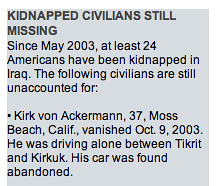
New feature over at the Department of Labor - Defense Base Act Summary Reports. And for unknown reasons, Ultra Services is not listed, neither for the disappearance of Kirk von Ackermann nor the drive-by shooting deaths of Ryan Manelick nor his Iraqi driver. Three distinct casualties just don't exist in the Department of Labor records.

Department of Labor
Office of Workers' Compensation Programs
Defense Base Act Summary Reports
DBA Reports by Employer
September 1, 2001 through December 31, 2010
Easy to assume it was a simple bureaucratic oversight. But here's the really strange part. A similar summary report was circulating among those who follow overseas contracting issues a few years back. And at that time, Ultra Services was included. Why did the Department of Labor decide to exclude Ultra Services?

Are any other casualties missing?

Defense Base Act/War Hazards Act Summary by Employer for Iraq
Department of Labor
As of 08/08/2006, page 7

Page 7
I first came across the 2006 Summary Report at the website for American Contractors in Iraq:
http://americancontractorsiniraq.com/files/contractor-deaths1.pdf

Tuesday, February 22, 2011

Reading Room

What follows is a list of publicly available manuals, instructions, regulations, laws and policies applicable to overseas Americans who go missing while working under contract for US government agencies. If links go bad, use a search engine like google to find updated information about the publication you seek.

Legal Reference Material

The laws that govern missing persons, hostage affairs, etc.

National Security Act of 1947 
Establishes intelligence community support for missing persons. See Section 117 POW/MIA Analytic Capability. Also see 50 USC § 404L: United States Code, Title 50 - War and National Defense, Chapter 15 - National Security, Subchapter I - Coordination for National Security, 404L - POW Analytic Capability. The National Security Act of 1947 was last amended in 2007 by Public Law 110-53.

U.S. Code Title 10 § 1513
Legal definition of a missing person. United States Code, Title 10 - Armed Forces, Subtitle A - General Military Law, Part II - Personnel, Chapter 76 - Missing Persons.

Missing Persons Act
10 USC § 1501 - 1513 (A) policy, control, and oversight within the Department of Defense of the entire process for investigation and recovery related to missing persons (including matters related to search, rescue, escape, and evasion); and (B) coordination for the Department of Defense with other departments and agencies of the United States on all matters concerning missing persons.

Presumed Death under the Missing Persons Act
States laws govern how presumption of death is determined for a missing person. This is a critical phase in getting benefits in a prompt manner to surviving family members. Sample law for Rhode Island.

Defense Prisoner of War Missing Personnel (DPMO)
Provides policy oversight for the mission to recover captured, missing, or isolated personnel, usually military.

Workers Compensation for Overseas Workers

Information on the survivors benefits, including eligibility, etc. Benefits are administered by the Department of Labor.

Longshore and Harbor Workers Compensation Act (LHWCA)
LHWCA forms the basis for workers compensation for overseas workers.

Defense Base Act (DBA) also known as 42 USC § 1651
Defense Base Act extends LHWCA protections to overseas workers employed under contract to US government agencies. Benefits are payable if a casualty is not the result of hostile force(s). 

Workers Compensation Clauses for Overseas Performance (PDF)
Article on the application of FAR 52.228-3 and FAR 52.228-4 contract clauses.

War Hazards Compensation Act (WHCA) also known as 42 USC § 1701
Coverage under WHCA is automatically extended to anyone who has DBA. Benefits are payable if a casualty is the result of hostile force(s).

Regulations under WHCA - Employees Benefits
Title 20 Part 61- Claims for Compensation under the War Hazards Compensation Act, as Amended

Federal Employee Compensation Act (FECA)
WHCA benefits are paid directly from the FECA fund

Regulations under FECA
Title 20 Part 10 - Claims for Compensation under the Federal Employees' Compensation Act, as Amended

Dept of Labor DBA LHWCA page

Dept of Labor Compliance Page - FECA WHCA

Reports, Policies, and Manuals


General information and resources.

From the US Department of State:

Foreign Affairs Manual (FAM)

3 FAM 4100 Foreign Affairs Manual
US State Department Employee Responsibility and Conduct
Including 'Guidelines for Personnel Taken Hostage'

7 FAM 000 Foreign Affairs Manual
Consular Protection of US Nationals Abroad

From the US Department of Defense:

Defense Contingency Contracting Handbook

DA PAM 715–16
Contractor Deployment Guide. Procedures for contractor operations within the Department of the Army. Chapters 10 & 11 cover a variety of issues for hostages, including identification, aid, rights, etc. Department of the Army, February 27, 1998

AR 715-9
Contractors Accompanying the Force, November 29, 1999

Field Manual FM 3-100.21 (formerly FM 100-10-2)
Contractors on the Battlefield, Department of the Army, January 3, 2003. General overview of responsibilities includes brief passages and references on Personnel Recovery, Next of Kin Notification, etc.

Army Publishing Directorate
Everything you ever wanted to read in PDF format from the US Army but can't get access to without a password and login. Great way to double check titles and numbers. Also see:
Department of the Army Official Publishing sites
Lists other websites to find publications - alas, some with secure logins

Army Knowledge Online (AKO)
All Departmental Publications and Forms, including distribution-restricted Items

Army Home Page (AHP)
All Unrestricted Departmental Publications and Forms

U.S. Army Publishing Directorate (APD)
Administrative Departmental Publications and Forms (ARs, CIRs, PAMs, OFs, SFs, DD and DA Forms)

U.S. Army Materiel Command (AMC) Logistics Support Activity
Technical and Equipment Publications(TMs, TBs and SCs)

U.S. Army Training and Doctrine Command
Training and Doctrinal Publications (FMs, PBs, TCs and STPs)

U.S. Army Corps of Engineers
Training & Doctrinal, Technical & Equipment Publications with Engineering & Design Criteria (TMs and FMs)

The Surgeon General/Medical Command
Training & Doctrinal, Technical & Equipment Publications with Medical Content (TMs, FMs, and SB 8-75 Series Publications)

Department of Defense Forms
Just what it sounds like. Standard forms galore. See DD Form 1833 Isolated Personnel Report (ISOPREP)
Standard Forms and Casualty Reporting

Everything starts with a standardized form for information.

SIGACT
Significant Activity reports are typically the very first incident report generated in the field.

SPOT
Synchronized Predeployment and Operational Tracker (SPOT). Registration for contractors working overseas.

DCIPS
Defense Casualty Information Processing System. Electronic reporting system used to report and track casualties.

AF CARES
Armed Forces Casualty Assistance Readiness Enhancement System, March 2007. Electronic system for tracking the progress of a casualty through the system. General order of flow: Initial Contact - Initial Visit - Interment - Disposition of Benefits - Disposition of Personal Effects - Disposition of Investigative Reports - Case After Action Report

Form DS-2060
Report of the Death of an American Citizen Abroad

Casualty Matters

AI Part 52.2 01  (DOC)
Basic form to provide to the Contracting Officer for reporting a hostage. See Part 52, page 31, Hostage Reporting instruction, Joint Contracting Command,  May 2007

AR 15-6 (PDF)
Commanders responsibilities in initiating an investigation of a casualty. Procedures for Investigating Officers and Boards of Officers, Department of the Army, October 2, 2006

AR 600-8-1 Army Casualty Program
Chapter 13 - Procedures for Casualties Involving Missing Persons (Non-Hostile and Hostile)

FM-27-1
Legal Guide for Commanders including authority for an AR-15 investigation

DODI 1300.18 Casualty Matters, Policies
Personnel Casualty Matters, Policies, and Procedures

DODD 1300.22
Mortuary Affairs, November 21, 2003 Disposition of remains, personal effects, etc.

DODD 2310.2
General policy for Personnel Recovery, Department of Defense, December 22, 2000

DODI 2310.4
Repatriation of Prisoners of War, Hostages, Peacetime Government Detainees and Other Missing or Isolated Personnel

DODI 2310.05 Missing Persons
Accounting for Missing Persons – Boards of Inquiry, Department of Defense, March 14, 2008

DODI 3001.03
Responsibility for disposition of human remains. Accounting for Personnel Lost in Past Conflicts – The Armed Forces Identification Review Board (AFIRB), March 14, 2008

Annual Reports of Missing Persons

Military Casualty and Loss

DOS Country Reports on Terrorism
Annual reports on terrorism incidents (includes kidnappings) of American citizens, listed by year since 2000. Country Reports on Terrorism, US Department of State

NCTC Reports on Terrorism
Annual reports of incidents. National Counterterrorism Center

WITS
Searchable database of worlwide terrorism incidents. Search kidnapping. Worldwide Incidents Tracking System, National Counterterrorism Center

Abbreviations

AI Acquisition Instruction 
AR Army Regulation
DODI Department of Defense Instruction
DODD Department of Defense Directive
FAM Foreign Affairs Manual (State Department)
FM Field Manual

Monday, June 21, 2010

Recent DBA Ruling in Texas

The following case centers on the undefined term of 'accident' within the Defense Base Act. I've read it through several times. There are some very fine points of law that I haven't quite grasped yet.

United States District Court For The Southern District Of Texas Deprives Battlefield Contractors Of The Protections Of The Defense Base Act
By Sheppard Mullin, Defense Contractor Blog, June 14, 2010

A recent decision by the United States District Court for the Southern District of Texas may have caused grave damage to protections long available to overseas government contractors and their employees under the Defense Base Act (“DBA”), 42 U.S.C. § 1651 et seq.

In Fisher v. Halliburton, 2010 WL 1268097 (S.D. Tex., Mar. 25, 2010), the court ruled the deaths and injuries sustained by a group of civilian convoy drivers in Iraq during insurgent attacks were not “accidents” and, therefore, that they were outside the scope of the protections afforded by the DBA. Absent the DBA’s protections, the Defendant employers are now in the legal “line of fire” – for the hefty compensable tort and negligence damages being alleged. The court, through its own motion, submitted its decision for immediate interlocutory appeal to the U.S. Court of Appeals for the Fifth Circuit. If upheld, the decision could mean an end to the substantial protection from tort liability that the seventy-year old act has afforded contractors deploying personnel to support combat operations.

More...
If I understand correctly - and I most definitely am not a lawyer - at the heart of the suit is whether or not Halliburton was willfully negligent in the deaths of the truck drivers. If yes, it would allow a liability suit to go forward outside of the Defense Base Act.

I guess what I would want to know is: what legal obligation did Halliburton have for the safety of those workers? Because workers would probably want to know before they accept a job if the answer is 'none.'

Addendum:

In related news, the Commission on Wartime Contracting (CWC), 'a body created in early 2008 to investigate waste, fraud and abuse in military contracting services in Afghanistan and Iraq', held hearings in Washington DC. Members of the major security companies were invited to attend.

Hearings Reveal Lapses in Private Security in War Zones
By Pratap Chatterjee, Inter Press Service, June 21, 2010

Excerpt:
The U.S. Agency for International Development (USAID) also came in for extended criticism when David Blackshaw, the division chief for overseas security, told the commission that his agency was not legally responsible for the actions of armed guards that accompanied their grantees. "The role of the USAID's SEC's International Security Programmes Division is limited to advice and counsel," Blackshaw told the commissioners.

The commissioners were incensed. Several of them pulled out copies of a USAID Office of Inspector General report on private contracting that was issued last month that stated a third of USAID private security contracts in Afghanistan have no standard security requirements.
Wow. It pretty much sounds like absolutely no one accepts responsibility for security. I find that creepy.

Update II: Good Lord. Talk about a conflict of interest. General Sanchez served as V Corps commander of coalition forces in Iraq from June 2003 to June 2004.

Side note: V Corps issued an identification badge to Kirk von Ackermann that later appeared in the Rolling Stone article, Death of a Contractor: Greed and Murder in Iraq's Lawless Desert by Daniel Halpern, March 8, 2007.

KBR Gives Uncle Sam the One Finger Salute
By David Isenberg, Huffington Post, July 3, 2010
In February it was reported that the U.S. Army [was] trying to stop [retired US Army Gen. Sanchez] from continuing to be an expert for KBR in a lawsuit against it over civilian truck driver deaths and injuries.

Sanchez is being paid $650 an hour and has reviewed documents and written a report that support's KBR's contention it should not be held legally responsible for the deaths of six civilian truck drivers and the injuries of others in a 2004 ambush in Iraq.

The suing drivers and family members contend that KBR should have stopped the convoys when it was warned that attacks would increase on April 9, 2004, the first anniversary of the day allies in the U.S.-led invasion of Iraq reached Baghdad.

KBR argues that the military approved sending the convoys out and several laws protect KBR from responsibility in a wartime situation. The Army contracts with KBR to provide transportation, food services and other logistical support.
....as the Army's own AR 15-6 Report clearly admits, but for the Army's failures in its own processes and procedures on April 9, 2004, the attack, injuries, and deaths associated with the Fisher case would never even have occurred.
Why does the US Treasury feel like it's turned into just one big ATM machine.

Related Reading

Commission on Wartime Contracting
Commissioners:
Michael J. Thibault
Christopher Shays
Clark Kent Ervin
Grant S. Green
Robert J. Henke
Katherine Schinasi
Charles Tiefer
Dov S. Zakheim

Wednesday, March 31, 2010

Lawsuit Filed Against US State Department

The families of three private security contractors - Joshua Munns, Jonathon Cote and John Young of Crescent Security Group, kidnapped in Iraq on November 16, 2006 and later beheaded - are suing the US State Department.

State Department sued in death of Anderson man, other contractors in Iraq
By Ryan Sabalow, The Record Searchlight, March 25, 2010
PDF of the suit accompanying the article Munns et al v. Clinton et al

Mark Munns of Anderson said in an interview Wednesday that the suit was filed in hopes of learning what U.S. officials know about the abduction and what steps they took to find his son, Joshua Munns, and the other men abducted with him. [...]

The suit demands the State Department pay the families their children's life insurance benefits because the contractors were working by proxy for the government at the time.

Crescent Security, the firm for which Munns and the other contractors worked, hasn't paid any death benefits owed to the contractors' surviving family members, the suit says.

The State Department also has been uncooperative in trying to help the family recover the money, the suit alleges.
Be sure to read the PDF of the actual court filing that accompanies the original article.

Looking over the suit, at the very least, it certainly sounds like Crescent Security held 'dead peasant' life insurance policies for its employees.

But what about injury and/or detention? If the Crescent Security insurance policy included Kidnap & Ransom (K&R), what kind of access did the insurance carrier provide to a hostage negotiator? If the company didn't carry injury and/or detention, then the families should qualify for benefits under the Defense Base Act regardless of whether or not Crescent Security carried DBA coverage.

Assuming precedent was set, William Palmer, Munns' attorney, may not be aware of a recent ruling from the Department of Labor in the case of Kirk von Ackermann who disappeared in Iraq on October 9, 2003.

An investigation by the Department of Defense determined von Ackermann was killed during a botched kidnapping by hostile forces. But because Kirk von Ackermann's employer failed to secure DBA insurance, there were substantial delays in awarding the survivor benefits due under the War Hazards Compensation Act. In late 2009, the Department of Labor finally issued a ruling finding in the von Ackermann family's favor and benefits awarded.

It all comes down to the question of just what kind and how broad was the war-risk hazard coverage Crescent Security carried on its employees.

One last thought on the suit...was Jennifer Foo the Casualty Assistance Officer assigned to the case as per the Missing Persons Act? Was Counsel appointed to represent the abducted men?

I've written about this before but just to recap: as American civilian contractors working in support of US operations in Iraq, the abducted employees should have been covered under legislation commonly known as the Missing Persons Act. Family should have received notification that counsel was appointed to represent the abducted men's interests within 45 days of detention. By Day 100, an unclassified summary report should have been provided to the men's family. At the one year anniversary, Day 365, they should have received notification of the meeting of a Board of Inquiry. If that board reached no definitive conclusion as to their whereabouts, additional inquiries should have been held which the family would have had the right to attend. Family could have passed concerns to the counsel as well as provide information and/or objections to any recommendations by the Board of Inquiry.

Additional Reading

The Business of Kidnapping - war-risk hazard premiums and hostage negotiators
February 16, 2010

Book - Big Boy Rules by Steve Fainaru
November 23, 2008

Munns et al v. Clinton et al in filings and dockets at Justia.com
Plaintiffs: Mark Munns, Crista Munns, Dennis Debrabander, Sharon Debrabander and Lori Silveri
Defendants: Hillary Diane Rodham Clinton and Jennifer Foo
Case Number: 2:2010cv00681
Filed: March 22, 2010
Court: California Eastern District Court
Office: Sacramento Office
Presiding Judge: Lawrence K. Karlton
Presiding Judge: Senior Judge Lawrence K. Karlton
Referring Judge: Kimberly J. Mueller
Referring Judge: Magistrate Judge Kimberly J. Mueller
Nature of Suit: Contract - Other Contract
Cause: 42:1983 Civil Rights Act

Previous related posts

A Sliver of Justice - finding by the Department of Labor in favor of the von Ackermann family
Janaury 10, 2010

Defense Base Act vs War Hazards Compensation Act- non-hostile vs hostile Type of Casualty
December 23, 2008

Iraq Contractors and The Missing Persons Act - legal obligations of the US Government
July 24, 2008

The Defense Base Act/War Hazards Compensation Act Handbook is on sale through Loyola College of Law for $60. Call (504) 861-5441 or Toll Free at (866) 250-8617 to order. For more information, email: clelaw@loyno.edu

Tuesday, February 16, 2010

Kidnapping

According to a recent article in The Australian, kidnapping as a new business venture is on the rise with 30-40,000 kidnappings estimated worldwide. There was a similar article in the Financial Times late last month. Depressing.

The business of kidnapping
By Joe Kelly, The Australian, February 17, 2010

John Chase is an expert in kidnap and ransom cases. The 48-year-old comes from an intelligence background, has more than 17 years' experience and is the managing director of crisis response at AKE group, which specialises in preparing people to enter some of the most hostile places on the planet. [...]

"There has to be a point where government's go to the families and say to those people very honestly, 'Look, we as governments cannot help you, but if you hire one of these internationally recognised companies you may be able to secure the release of your loved ones.' The hostages just went through such trauma in those first 339 days. It's not right."
Tales of the hostage negotiators
By James Boxell, Financial Times, January 21, 2010
As well as ransoms, insurance policies also cover psychological counselling for victims and families, media consultancy on reputation risk and the salary of replacement workers.
PS This is getting down into the weeds...but both of the above articles are in relation to hostage negotiators hired by insurance underwriters when a policyholder has been kidnapped. In other words, a company carries Kidnap & Ransom (K&R) on its employees working in risky environments - such as Iraq. Employees are not informed they are covered by kidnap risk insurance - a practice eerily similar to 'dead peasant' life insurance policies that pay employers benefits if an employee dies.

Under the Defense Base Act (DBA), when an American contractor pays an additional premium for war hazard risk - and I would imagine this includes kidnap risk - coverage under the DBA is exempt. Which raises the question of what kind of benefits kidnap risk policies pay and to whom. Are there survivor benefits for a hostage's family while they remain missing? Or are benefits paid out solely to the corporation?

Like I said above, depressing.

Editor's note: the Missing Man turned 5-years old with this post.

Monday, January 11, 2010

T. Christian Miller on Fresh Air

Journalist T. Christian Miller was recently interviewed by Terry Gross for NPR's Fresh Air where he discussed contractors and their fight for care. Fingers crossed that issues surrounding implementation of the Defense Base Act are finally getting braoder public attention.

Wounded In Wars, Civilians Face Care Battle At Home
NPR, January 11, 2010

Miller, who wrote the book Blood Money: Wasted Billions, Lost Lives and Corporate Greed in Iraq, joins Fresh Air for a conversation about the battles these civilians face to get surgery, psychological counseling and even prosthetics — and explains the ins and outs of the laws and policies governing who's responsible for their predicament.
At ProPublica, read Miller's ongoing series, Disposable Army: civilian Contractors in Iraq and Afghanistan.

Sunday, January 10, 2010

A Sliver of Justice

They say, no good deed goes unpunished. I'm hoping that won't end up being the case to this particular story.

Back in March of 2007, ePluribus Media published the first article in a three-part series which I wrote, Iraq, Contingency Contracting and the Defense Base Act. In part, the article highlighted the situation of the von Ackermann family and the lack of insurance benefits they received after Kirk von Ackermann, a civilian contractor, disappeared in Iraq in 2003.

Von Ackermann's employer at the time, Ultra Services of Istanbul Turkey, did not carry Defense Base Act insurance, similar to workman's compensation for overseas contractors. The Defense Base Act pays benefits if a contractor is killed, injured or missing. Claims under the Defense Base Act are administered by the Department of Labor.

As a result of that series, an attorney retired from the Department of Labor contacted me with questions about the article and in particular, the plight of the von Ackermann family. I pointed him to the Missing in Iraq blog and as Megan has noted at her blog, he went on to eventually take on their case.

It is my understanding that he pursued benefits for the family under the War Hazards Compensation Act. The War Hazards Compensation Act is a component of the Defense Base Act but applies only to those killed, injured or missing due to the actions of hostile forces. The War Hazards Compensation Act reimburses by 100% all benefits. As the US Army CID had determined in 2006 that Kirk von Ackermann was abducted and killed by hostile forces, the claim falls clearly under the War Hazards Act.

In other words, even if Kirk von Ackermann's employer had secured Defense Base Act insurance as required, all benefits would have been reimbursed by the Federal Government any way, in effect rendering the middle man of an insurance company as moot.

While I don't know the details beyond what Megan von Ackermann has posted on her blog (see Yuliscious), just shortly before Christmas, a check arrived from the Department of Labor - over 6 years after Kirk von Ackermann disappeared in Iraq. The Department of Labor finally recognized her claim.

Without ePluribus Media, that little bit of righting a wrong might never have happened. I'd like to take a moment to thank here everyone who helped make the series possible.

Original credits for those who worked on the article, proofreading, editing, fact checking, etc at ePluribus Media are: rba, newton snookers, cho, intranets, steven reich, greyhawk, wanderindiana, XicanoPwr, standingup, roxy

Additional Reading

Yuliscious
By Megan von Ackermann, Missing in Iraq, December 24, 2009

Defense Base Act vs War Hazards Compensation Act - graphic
December 23, 2008

The Defense Base Act - insurance for contractors
April 6, 2007

Iraq, Contingency Contracting and the Defense Base Act - reprint
March 7, 2007

Monday, September 28, 2009

Quiet on the Western Front

Assorted bits and pieces....

ePluribus Media articles

I've cross-posted most of my old articles from ePluribus Media to the Missing Man archives. The posts are backdated to coincide with the original publication dates. The Missing Man was always intended to be a library of materials, all be it one with a very narrow focus of interest. Enough time has passed that it seemed appropriate to include the full text of the articles here.

Review of The Curse of the al Dulaimi Hotel
By Susie Dow, ePluribus Media, August 18, 2008

Missing Contractor: U.S. Military Mechanics May Hold the Keys
By Susie Dow, ePluribus Media, April 21, 2008

Iraq, Contingency Contracting and the Defense Base Act
By Susie Dow, ePluribus Media, March 4, 2007

One Missing One Dead: An Iraq Contractor in the Fog of War
By Susie Dow, ePluribus Media, May 21, 2006

FOIA

Still no word on my administrative appeal regarding the FOIA request with the NSA. Nor any word on another equally important FOIA request with CENTCOM for base access records, short of the confirmation that the request was in fact received.

In case I've never mentioned it before, the base access FOIA request seeks entrance and exit records for all of the bases in the northeast of Iraq for any and all Ultra Services personnel within a limited time frame. Specifically, records from the three days before and after Kirk von Ackermann disappeared. I'm hoping the records will disprove my own hypothesis that Kirk von Ackermann visited another base to fix a wonky tire after he left FOB Pacesetter.

Why disprove rather than prove the hypothesis? It's impossible to prove von Ackermann entered or exited area bases if no record exists. Absence of a record is not in itself proof. It's only possible to disprove von Ackermann did not visit a base if a record shows that in fact he did.

Missing in Iraq

Megan von Ackermann has been writing over at her blog, Missing in Iraq, about legal action regarding survivor benefits stemming from her husband's disappearance that is slowly winding its way through the system. The basis of the suit is the Defense Base Act. I've compiled links to recent posts below:

Fallout
By Megan von Ackermann, Missing in Iraq, July 20, 2009

Reality
By Megan von Ackermann, Missing in Iraq, June 29, 2009

Re-charted
By Megan von Ackermann, Missing in Iraq, June 26, 2009

Charted
By Megan von Ackermann, Missing in Iraq, June 24, 2009

Ideal
By Megan von Ackermann, Missing in Iraq, June 11, 2009

Reluctant
By Megan von Ackermann, Missing in Iraq, June 5, 2009
And speaking of the Defense Base Act....

Several recent articles by T. Christian Miller on the Defense Base Act. (Click on his name to check out more of Miller's articles at ProPublica.) There's some misguided criticism around the web that the Defense Base Act works just fine and no changes are needed. Funny: the various editorials are not written by contractors rather, such editorials are usually penned by folks who directly benefit under the current system, like lawyers and insurance executives. Funny that.

Pentagon Study Proposes Overhaul of Defense Base Act to Cover Care for Injured Contractors by T. Christian Miller, ProPublica - September 15, 2009 6:52 pm

Congressman Announces Plan to Reform U.S. System to Care for Injured Civilian Contractors by by T. Christian Miller, ProPublica - September 9, 2009 5:19 pm

Sometimes It’s Not Your War, But You Sacrifice Anyway by by T. Christian Miller, ProPublica - August 17, 2009 9:19 am

Company That Probes War Contractor Injuries for AIG Is Itself Under Scrutiny by by T. Christian Miller, ProPublica - July 31, 2009 4:06 pm

Thursday, May 07, 2009

Contractors and Overseas Clinics

Contractors Using Military Clinics
By Walter Pincus, Washington Post, May 7, 2009

Military clinics and field hospitals in Iraq and Afghanistan have supplied more than $1 million a month in health-care services to civilian contractors during the past two years without seeking reimbursement from their employers, as provided by law, according to a new audit by the Defense Department inspector general.

The report, issued Monday, noted that all costs associated with both emergency and primary medical care are reimbursable to the government and are the responsibility of the contingency contractor personnel, their employer or their health insurance provider.
The United States desperately needs to overhaul its entire health care system and just provide care for everyone. 

The Report itself is an interesting read. I admit I kept wondering why does the government even rely on private insurance when using contractors overseas? It just adds a middle man with fees resulting in an unnecessary expense. Not to mention, half of the insurance companies fight or severely delay payments. So what's the benefit of using private insurance to begin with?

D-2009-078 PDF Health Care Provided by Military Treatment Facilities to Contractors in Southwest Asia 
Office of the Deputy Inspector General for Auditing, May 4, 2009 
(Project No. D2008-D000LF-0241.000)

Statistic from the Report:
U.S. Central Command (USCENTCOM) census data for the first quarter of FY 2008 stated that there were about 223,200 contractor personnel in USCENTCOM’s area of responsibility.
As a side note, according to this press release, as of August 1, 2008, there were 134 investigations involving contracts for Southwest Asia (Iraq and Afghanistan). Fascinating website. I should hang out there more often.

Department of Defense - Office of the Inspector General

ADDENDUM

Military Fails to Collect From AIG for Care to Injured Contractors
by T. Christian Miller, ProPublica, May 7, 2009
The report, however, found that no agency in the Defense Department enforces the policy. Insurance carriers or defense contractors are rarely charged when civilian contractors are treated at military medical facilities, the report found.

As a result, the Pentagon often pays twice for contractors' medical care: once in paying premiums to AIG and other carriers for insurance and a second time in failing to bill the companies for providing care to injured civilians.
ADDENDUM II

Senate Hearing on AIG Care for Contractors Injured in Iraq Postponed Until June
by T. Christian Miller, ProPublica, May 12, 2009

Thursday, March 26, 2009

Contractor Deployment Guide

I was looking for more background information on general identification requirements for contractors working overseas when I stumbled upon this Pamphlet. Fascinating reading. As far as I can tell, this is the most recent version. It really is a must read for anyone going to work overseas.

Ed. note for June 14, 2010: please use this new link DA PAM 715-16

Contractor Deployment Guide
Pamphlet 715–16
Department of the Army
27 February 1998

DA PAM 715–16
Contractor Deployment Guide

This new Department of the Army pamphlet provides procedures for contractor operations within the Department of the Army.
The Pamphlet includes a short section on Hostages (see page 6), which contains some information that I don't recall reading before.
Chapter 11

11–1. Hostage aid

a. Hostages

When and where the Secretary of State, in consultation with the Secretary of Labor, declares that U.S. citizens or resident aliens of the United States rendering service overseas have been placed in a “captive” status as a result of a “hostile action” against the U.S. government, a wide range of benefits accrue to that person and that
person’s dependents. For example, captives can continue to receive their full pay. Captives can claim some, but not all, of the benefits of the Soldiers’ and Sailors’ Civil Relief Act. A person designated as a captive or his/her family members are eligible for physical and mental health care benefits at U.S. government expense. A spouse
or unmarried dependent of a designated captive is eligible for certain education benefits. If a designated captive ultimately dies from hostile action caused by his/her relationship to the U.S. government, the Secretary of State may provide death benefits to the captive’s survivors.

b. Any person possibly affected (e.g., family members and dependents) may petition the Secretary of State to make the declaration of coverage. Pursuing benefits and remedies under these laws is up to the contractor employee and/or the employee’s family members, dependents or employer.
As far as identification...no surprises. Seems basic. But what exists on paper and what's done in reality are two different things. So, the question that really needs answering is: what identification were Ultra Services personnel expected to carry back in Iraq in 2003?

Identification mentioned in the Contractor Deployment Guide:
Passport
Visas - as needed
Invitational Travel Orders
Uniformed Services Identifications and Privilege Card (DD Form 1173)
Geneva Conventions Identity Card (DD Form 489)
Personal Identification ('dog tags')
Local In-theater Identification (Baghdad International Airport, etc)
Authorization to carry a weapon (from Theater Commander or State Department)
Record of Emergency Data Card (DD Form 93)
Company Id
Drivers license
Record of Immunizations
Medical information ('medical tags')
Not mentioned:
Common Access Card (DD Form 1172-2)
Looking over the list above, what exactly was the green id card issued to Kirk von Ackermann featured in the Rolling Stone article? Was it still valid? And what happened to all of the other identification he should have been carrying?

Always questions.

Related

Base Access
March 20, 2009

Tuesday, March 03, 2009

Annual Longshore Conference

Photo Source U.S. Navy's Military Sealift Command

The Annual Longshore Conference is March 19 - 20, 2009 in New Orleans, Louisiana. I attended the previous conference organized by Loyola University College of Law and the U.S. Department of Labor in the fall of 2008 in Washington D.C. and found it very informative. Pretty much everyone who knew anything about the Defense Base Act was there.

From the registration brochure:

This year’s program will address several timely topics of importance to any workers’ compensation practitioner.

We will examine issues of competing jurisdiction. Despite decades of litigation seeking clarity in competing jurisdictional schemes, significant problems remain in navigating the myriad compensation programs that exist in the maritime field. Recent amendments to the Americans With Disabilities Act will impact return to work issues in workers’ compensation claims. Medicare Set-Asides continue to be important in settlements of longshore claims, and recent changes to the regulations and procedures for MSA will be explained.

We will also address various practice issues, such as trying claims before the Office of Administrative Law Judges, posthearing proceedings, and attorney fee claims. We will have medical experts address the expanding field of chronic pain conditions, and the diagnosis and treatment of these disorders. With the War on Terror continuing in both Iraq and Afghanistan, we will explore the Defense Base Act and War Hazards Compensation Act, as these remain important extensions of the [Longshore and Harbor Workers' Compensation Act] LHWCA.
The Defense Base Act/War Hazards Compensation Act Handbook is on sale through Loyola College of Law for $60. Call (504) 861-5441 or Toll Free at (866) 250-8617 to order. For more information, email clelaw@loyno.edu

For anyone with an interest in the Defense Base Act and/or issues facing American contractors working overseas, absolutely buy a copy of the DBA/WHCA Handbook. Most of the chapters were written by lawyers and judges whose careers are narrowly focused in DBA law.

Additional Reading

Defense Base Act Practice: We're Not in Kansas Anymore
By Roger A. Levy, Editor of the DBA/WHCA Handbook, Lexis/Nexis, August 19, 2008

U.S. Department of Labor
The Longshore and Harbor Workers’ Compensation Act (LHWCA) webpage

Tuesday, December 23, 2008

Defense Base Act vs War Hazards Compensation Act


This post looks at the significance of a non-hostile event vs a hostile event in determining how a casualty will be handled under the Defense Base Act. Any errors are strictly my own and, as always, corrections are very much welcome.

Casualty

Under United States policies and laws, a casualty is composed of a) TYPE, b) STATUS, and c) CATEGORY.

a) TYPE:
(1) non-hostile or
(2) hostile

b) STATUS:
(1) deceased or
(2) duty status – whereabouts unknown (DUSTWUN) for military, or excused absence – whereabouts unknown (EAWUN) for civilians or
(3) missing or
(4) very seriously ill or injured (VSI) or
(5) seriously ill or injured (SI) or
(6) not seriously ill or injured (NSI) or
(7) Returned to Military Control (RMC) or
(8) Pending - for preliminary reports only

At the DoD Component’s discretion, an additional casualty Status may be used - generally used for illnesses that require hospitalization:

(9) Special Patient (SPECPAT) or
(10) Special Category (SPECAT)
c) CATEGORY:
There are a wide variety of casualty categories depending on the status. For example, categories used for 'Status - Missing' are - Beleaguered, Besieged, Captured, Detained, Interned, Missing, Missing in Action (MIA), and again, Pending is for preliminary reports only.
POW is not a casualty status for reporting purposes, rather Status and Category are "Missing-Captured."

The key to understanding the difference between the Defense Base Act and the War Hazards Compensation Act lies in the TYPE of casualty: non-hostile vs. hostile

Laws

The Defense Base Act is an extension of the Longshore and Harbor Workers' Compensation Act - the equivalent of worker's compensation for Americans working overseas for US government agencies.

The Defense Base Act is, in effect, a group of laws: Defense Base Act (1941), War Hazards Compensation Act (1942), Mutual Security Act (1958), and in part the Dayton Peace Accords (1995). In addition, the Federal Employees Compensation Act (1916) applies should an incident qualify under the War Hazards Compensation Act.

Because coverage under the Defense Base Act is a legal requirement, premiums paid by a contractor are a reimbursable expense under the terms of the contract. Contracts should carry the relevant contract clauses (see: PDF - Memorandum: Inclusion of Defense Base Act Clause in DoD Overseas Contracts 08 Dec 2003).

Defense Base Act vs War Hazards Compensation Act

Incidents are divided into two types: NON-HOSTILE and HOSTILE. Casualties the result of a Non-Hostile event are covered under the Defense Base Act. Casualties the result of a Hostile event, however, are covered under the War Hazards Compensation Act.

The following graphic is an attempt to help clarify the difference between the Defense Base Act and the War Hazards Compensation Act.

right click to open in a new window

Claims arising from incidents that are the result of non-hostile action generally are reported under the Defense Base Act and as such are 15-40% reimbursable. [see note below] Claims arising from incidents that are the result of hostile action are paid under the War Hazards Compensation Act and subsequently the Federal Employees Compensation Act and consequently are 100% reimbursable.

Example:

John Brown sprains his ankle getting out of his truck in Iraq. Even though he's working in a war zone, the type of incident is non-hostile. Claims will be covered under the Defense Base Act. The claims will be reimbursed at 15-40%.

Bob Jones sprains his ankle getting out of his truck in Iraq as he attempts to retreat from mortar fire. Even though the injury is physically and medically identical to that of his co-worker, John Brown, the incident is the result of hostile action. Claims will be covered under the War Hazards Compensation Act and subsequently the Federal Employees Compensation Act. The claims will be reimbursed at 100%.

Previous related posts

Casualty Status of Missing

Iraq Contractors and The Missing Persons Act


Note (added July 19, 2009)

Figures were provided by Department of Labor personnel during several presentations at the Defense Base Act conference in Washington DC in the fall of 2008. The vast majority of claims filed under the Defense Base Act are for injuries. Expense to be reimbursed is usually for Loss Time - that is, the amount of time that an employee is unable to work due to the injury - but only if more than 4 days. The first 4 days are expected to be paid as sick days by an employer, and are not reimbursed.

As a result, the bulk of the claims - which again are for injuries - generally end up being reimbursed at 15-40%. In more concrete terms, the vast majority of injuries result in a time loss of 5 to 7 days of which 1 to 3 days, roughly 15-40%, will be reimbursed.

The Department of Labor breaks down Loss Time as follows:
NLT - No Loss Time - No lost time and no medical expense
NL0 - No Loss Zero - No lost time and no medical expense * but may result in a later claim, Questionable No Lost Time Injury**
NL4 - No Loss Four - No lost time, medical expense incurred or expected *
DEA - Death
COP - Continuation of regular pay*
OTH - Other
* found on a DOL form for Federal Employee's Notice of Traumatic Injury and Claim for Continuation of Pay/Compensation
** CHAPTER 1-300 - INDEX AND CONTROL at the Department of Labor website

Friday, October 24, 2008

Defense Base Act Conference

I'm in Washington D.C. to cover the Defense Base Act Conference for ePluribus Media this week. The first of what I hope to be several articles is now available:

Defense Base Act Conference - Part 1
By Susie Dow, ePluribus Media, October 23, 2008
Later this afternoon, Thomas Giblin of the U.S. Department of Labor and Roger Levy, the Editor-in-Chief of the new Defense Base Act and War Hazards Compensation Act Handbook, are scheduled to speak on the War Hazards Compensation Act, specifically - Detention Benefits. The Conference has been extremely informative to date. The Handbook is a must have for anyone interested in this relatively obscure area of workers' compensation programs.

On a more personal note, I just want to take a moment to thank the Editors at Lexis Nexis for including The Missing Man under the new Handbook's section on blogs in the Introduction to the Defense Base Act, Section 1.06 (page 1-11). 

Wow. I'm stunned. 

As some of you know, my interest in the Defense Base Act is the direct result of learning that Ultra Services wasn't carrying "insurance" when an employee, Kirk von Ackermann, disappeared in Iraq back in October of 2003. I spent two years trying to find out what happened, resulting in the article listed below. 

A brilliant intelligence analyst with the U.S. Air Force prior to becoming a contractor, Kirk von Ackermann today continues to be the longest missing American civilian in Iraq.

Additional Reading

Iraq, Contingency Contracting and the Defense Base Act - 3 part series
by Susie Dow, ePluribus Media, March 28, 2007

Monday, May 26, 2008

Contractor Casualties: An Update

The Committee on Oversight and Government Reform recently held a hearing, Defense Base Act Insurance: Are Taxpayers Paying Too Much? on Thursday, May 15, 2008.

Tucked into the Supplemental Information on Defense Base Act Insurance Costs are recent casualty numbers on contractor fatalities and injuries in Iraq and Afghanistan, taken from two reports by the Department of Labor dated April 2, 2008.

  • Department of Labor, Defense Base/War Hazards Act Summary by Nation for Afghanistan (Apr. 2, 2008)
  • Department of Labor, Defense Base/War Hazards Act Summary by Nation for Iraq (Apr. 2, 2008)
However, the numbers cited in the Supplemental are not broken out by nation. And at best, they are only a minimum.
Contractor Casualties as of April 2, 2008

1,292
killed
9,610 wounded
Kirk von Ackermann and Ryan Manelick are not included in those figures.

Regarding DBA insurance? It's a cash cow for insurers.

The new Defense Authorization Bill passed in the House, H.R. 5658, includes an Amendment "...requiring that DOD implement a new approach to purchasing DBA insurance within the next 18 months." So far, I have been unable to locate the full text language but it's certainly a very long overdue step in the right direction. Hopefully, the Amendment will make it through the Senate and into the final version of the bill.

Wednesday, April 11, 2007

Jeffrey Ake

An American contractor, Jeffrey Ake of LaPorte, Indiana, disappeared in Iraq two years ago today. The side bar to an AP article about Jeffrey Ake today mentions Kirk von Ackermann as still missing.

A Hoosier's fate remains uncertain
By Will Higgins, The Indianapolis Star, April 11, 2007

Recent news reports have highlighted that the Ake family have had a hard time financially. With the large number of contractors now working in Iraq for United States agencies, is it really too much to ask that each and every contractor at least be covered by a minimum of insurance? Families shouldn't have financial stress added on top of the pain and worry of a missing family member.

See The Defense Base Act for more on the topic of insurance.

Friday, April 06, 2007

The Defense Base Act

In early 2005, I became aware that Kirk von Ackermann, a civilian contractor working in Iraq, was not covered by "insurance" when he disappeared on October 9, 2003. I sought to find out a) what was this "insurance" and b) why was it missing? The result of the ensuing two years of research -- in to what I would quickly learn was the Defense Base Act -- is a three-part series for ePluribus Media of which the first part is now available.

Part I traces how the lack of adequate insurance coverage impacts families. In particular, it goes into some detail on how lack of Defense Base Act coverage impacted the von Ackermann family.

Part II concentrates on how the appropriate Defense Base Act contract clauses that could have made a difference went "missing in action."

Part III focuses on the lack of information and access to low cost coverage for contractors based overseas.

Iraq, Contingency Contracting and the Defense Base Act
by Susie Dow, ePluribus Media, March 28, 2007

Established in 1941, the Defense Base Act (DBA) provides the equivalent of workers' compensation for civilian contractors working on contingency operations in overseas countries such as Iraq and Afghanistan. DBA provides benefits in the event contractors are injured, killed, or kidnapped in the course of their work for US government agencies such as the various branches of the Department of Defense, USAID, or the State Department. But this insurance is not automatic, employers must purchase it. And before they can do that, they must know about it.

More...
Parts II & III will be posted over the next several weeks. I'll update this post with links once available.

Sunday, March 04, 2007

Iraq, Contingency Contracting and the Defense Base Act

This is a reprint of my article,
Iraq, Contingency Contracting and the Defense Base Act
By Susie Dow, ePluribus Media, March 4, 2007

Introduction

Iraq contractor. Those two words evoke different reactions from different people. For the families of the contractors who have been injured, kidnapped or killed as a result of simply doing their jobs,there's a much more pressing concern than public opinion: insurance.

In early 2005, Susie Dow became aware that a civilian contractor, Kirk von Ackermann, was not covered by "insurance" when he disappeared in Iraq on October 9, 2003. She sought to find out why. The story that follows is based on research, interviews, correspondence, documents, emails, and phone calls over a two year time span.

The first part of this series traces how the lack of adequate insurance coverage impacted families already suffering the deaths or uncertainty surrounding the status of their family members serving in Iraq or Afghanistan as civilian contractors. Part II concentrates on why the appropriate Defense Base Act clauses that could have made a difference went "missing in action." Part III focuses on the lack of information, training and access to low cost coverage for contractors based overseas.

Susie Dow has followed the Missing Man story since February 27, 2005. Her first ePluribus Media story One Missing, One Dead; An Iraq Contractor in the Fog of War, follows the tale of two American civilian contractors.

Part I - Insurance

Kirk von Ackermann is missing.

So is his fellow worker, Ryan Manelick.

Although both men, contractors in the Iraq theater, have been declared dead, they are both missing from the official statistics of the injured or deceased maintained by the Department of Labor.

But let's back up a minute:

On March 18, 2003, one day before the start of the war in Iraq, Defense acquisition personnel were given a presentation that outlined recurring problems with insurance for contractors: contracts from the Department of Defense (DOD) were too often excluding Defense Base Act clauses, the very clauses that provided a modicum of insurance protection for civilian contractors. While both the State Department and the US Agency for International Development (USAID) secured low cost insurance for their overseas workers, the Pentagon consistently did not implement efforts for department-wide coverage. The rationale? To many, it seemed that for the DOD, saving money [1] was considered more important than broad access to coverage [2], coverage that would ensure surviving family members of kidnapped or killed contractors received compensation [3].

History of the Defense Base Act

Established in 1941, the Defense Base Act (DBA) [4] provides the equivalent of workers' compensation for civilian contractors working on contingency operations in overseas countries such as Iraq and Afghanistan. DBA provides benefits in the event contractors are injured, killed, or kidnapped in the course of their work for US government agencies such as the various branches of the Department of Defense, USAID, or the State Department. But this insurance is not automatic, employers must purchase it. And before they can do that, they must know about it.

According to a January 23, 2007 USA Today and AP wire services story, the Department of Labor who administers DBA benefits, reports that at least 770 contractors have died [5] and 7,761 contractors have been injured in Iraq between March 2003 to December 31, 2006.

At least two American contractors should be listed: Ryan Manelick and Kirk von Ackermann. They are not, however, included in DBA casualty figures.

[Editor's note: in October 2008, author Susie Dow learned that the Department of Labor did not release casualty information on companies with fewer than 7 incidents out of concern for privacy. However, the policy is not a legal requirement and as a result, its merit is questioned.]

The Slow Pace of Bureaucracy

Deirdre A. Lee, former Director of Defense Procurement and Acquisition, attended that March 18th, 2003 briefing [6] of the Defense Acquisition Excellence Council, highlighting that contracts with the Department of Defense did not always include the required DBA contract clauses.

Seven months after that briefing, on October 9, 2003, civilian contractor Kirk von Ackermann working for Ultra Services of Istanbul, Turkey, which fulfilled logistics contracts for the US Army, disappeared in Iraq.

Nine months after that same briefing, on December 8, 2003, Director Lee belatedly issued a policy memo to [7] Defense agencies indicating that DBA was a required contract clause that should be included in overseas contracts where appropriate. Within one week, von Ackermann's colleague, Ryan Manelick, was gunned down after leaving a meeting at a base in Iraq.

Eighteen months after that briefing, the two Ultra Services principals would learn for the first time of the necessity of DBA insurance, too late to cover either of the two men. With no coverage, both men are omitted from the statistics the Department of Labor compiles on Iraq contractors.

The Family Left Behind

When Kirk von Ackermann disappeared on that October day in 2003, he left behind a wife and three children.

Within a month of first learning about the Defense Base Act in March 2004, Megan von Ackermann filed a claim for compensation. To contact her husband's employer Ultra Services, which by that time had ceased operations, a claims examiner faxed a letter of inquiry dated August 5, 2004 ultimately reaching Ultra Services' principals John Dawkins and Geoff Nordloh. The inquiry requested information on von Ackermann's disappearance as well as the name and address of Ultra Services' Defense Base Act insurance carrier.

But, Ultra Services didn't have DBA insurance. In fact, the company principals had never even heard of DBA during the time of their work in Iraq despite the fact that Ultra Services had processed over $12 million in contracts.

And even though Nordloh and Dawkins had also fulfilled millions of dollars in contracts for the US Army in Afghanistan, they only had just first learned of the Defense Base Act requirement from another contractor, construction giant Perini, through a draft of a proposed subcontract for work with the US Army in Afghanistan in the summer of 2004. In none of Dawkins' or Nordloh's previous prime contracts had the US Army ever mentioned the need for DBA.

Meanwhile, Megan von Ackermann had another problem -- her husband was considered "missing," not dead. The Department of Labor initially indicated that they needed the US Army's Criminal Investigation Division's (CID) findings into her husband's disappearance before they could decide her claim's status.

On August 9, 2006 -- two years after the initial letter was faxed -- the CID informed Megan von Ackermann that they had determined that her husband, a former Air Force Captain, had been killed on October 9, 2003 during a botched kidnapping [8]. While CID's determination allows Megan to move forward with processing a claim, it doesn't resolve the issue that Ultra Services didn't have DBA insurance at the time of her husband's disappearance. To this date, his remains still have not been found.

The von Ackermann family is unlikely to ever collect DBA benefits. Worse, since Kirk von Ackermann was considered a missing person for almost three years, and as a result, his family was not eligible for Social Security survivors' benefits [9], until the determination by CID. For the von Ackermann family, meeting day-to-day expenses is an ongoing problem:
I worry about money constantly - and I hate it. I don't want to reduce our situation to finances, and in a way I'm afraid the stress over money is masking the pain of our loss. The two things are so huge... and that hurts too; it hurts that being poor is nearly as difficult as losing Kirk. -- Megan von Ackermann [10]
Unfortunately, the von Ackermann family's experience is not unique. An Associated Press article reported Lillian Ake, wife of missing Iraq contractor Jeffrey Ake, is also unable to collect benefits. While she and her four children have received financial support through her church, Lillian Ake has placed their family home on the market in addition to beginning bankruptcy proceedings for her husband's business. [11] Jeffrey Ake was last seen being held at gunpoint in an April 13, 2005 video.

Contingency Contracting

Like Jeffrey Ake, Kirk von Ackerman and Ryan Manelick were civilian contractors working in a "contingency operation." As designated by the Secretary of Defense, Operation Enduring Freedom (OEF) in Afghanistan [12] and Operation Iraqi Freedom (OIF) in Iraq [13] are both contingency operations. [14] As such, the procurement of goods and services in support of these operations is known as Contingency Contracting and is performed by Contingency Contracting Officers (CCOs). [15]

Contingency contracting, by its very nature of working in close proximity to the battlefield, brings high risks. Civilian contractors deliver much needed supplies and services and, in doing so, often find themselves situated closer and closer to hostilities as competitive outsourcing through the US government's A-76 [16] program increasingly determines the most cost-effective way to fulfill government operations is through the private sector.

Contractors

Based on a survey for CENTCOM [17], and as reported in a December 5th, 2006 Washington Post article, more than 100,000 American and Third Country National civilian contractors [18] are estimated to currently be working in Iraq. Notably, this number does not include their sub-contractors. Requiring DBA insurance coverage depends in part on the "type" of support a civilian contractor provides.

Three types of civilian contractors are on or near the battlefield supporting contingency operations:
Systems support contractors maintain specialized equipment, generally sophisticated weapons. [19]

Theater support contractors are contracted by contingency contracting officers to provide immediate goods and services, generally by local vendors.

External support contractors, perform logistical support such as base construction and maintenance.
Ultra Services, the company Von Ackerman and Manelick worked for, was an external support contractor, similar to the more well-known, although much larger, Halliburton subsidiary Kellogg, Brown and Root (KBR). In fact, as external support contractors, ------------. KBR administers the Logistics Civil Augmentation Program (LOGCAP) III contract for the US Army.

According to one former US Military contracting officer, as a result of LOGCAP, KBR has its own contracting officers who procure goods and services for the Department of Defense's contingency operations. KBR employees are required to be covered by DBA insurance and, per the terms of the LOGCAP contract, KBR also requires that their subcontractors be adequately covered by DBA insurance as well. [20]

Had everything gone according to the Pentagon's plans, Halliburton's KBR unit would have handled most of the contracts for logistics in Iraq. [21] Companies such as Ultra Services would have served as subcontractors to KBR so that, by default, their employees would have been covered by DBA insurance coverage. Unfortunately for the von Ackermann family, the Pentagon's assumptions met a different reality.

Who Cares?

The Department of Defense was obligated to have all of its contractors who are legally required to carry DBA insurance to do so. Unfortunately, the Department of Defense's implementation was less aggressive than other US governmental agencies.

Whereas the State Department and USAID had for many years secured reasonable rates from insurance carriers for DBA, rates that added less than 5% to contract costs, the Department of the Defense did not. For other agencies, rates remained low as underwriters spread risks, charging the same rates in safer countries. But for years, the Department of Defense resisted efforts to secure broad coverage for its contractors. By the time the Department of Defense solicited competitive bids, its efforts met failure:
"On August 8, 2003 after the invasion, the Defense Department asked insurance agencies to submit proposals for selling discounted death and injury coverage to military contractors in Iraq, Afghanistan and Kuwait.

Not a single insurance company bid on the solicitation, which expired September 2, 2003 because the risks were too high to make it profitable." [22]
At the same time that the Department of Defense was failing to secure DBA insurance for its contractors at a reasonable cost, Operation Enduring Freedom was nearing the end of its second year in Afghanistan; Operation Iraqi Freedom, was nearing the end of its first six months. Meanwhile, DBA insurance rates for Department of Defense contractors – not surprisingly -- had skyrocketed well above those of USAID and State Department contractors, in some cases almost doubling overall contract costs. [23]

Eventually, the Department of Defense would later learn it was paying out as much as 10 times more in premiums than the other two government agencies [24]. The US taxpayer, of course, picked up the tab. [25]

Part II: DBA Clauses Missing In Action

The first part of this series traced how the lack of adequate insurance coverage impacted families already suffering the deaths or uncertainty surrounding the status of their family members serving in Iraq or Afghanistan as civilian contractors. Part II concentrates on how the appropriate Defense Base Act contract clauses that could have made a difference went "missing in action."Missing in Action

For those writing and administering contracts, whether or not to include the appropriate Defense Base Act (DBA) clauses requiring insurance protection for civilian contractors is left to individual contracting officers. At best when the appropriate clauses are missing, the contract was mistakenly assumed to be exempt. At worst, the clause was overlooked or never considered.

Gray Zone

Department of Defense contracts are generally divided into three types: services, supplies, and construction.

Both "services" and "construction" contracts require DBA clauses. But civilian contractors who provide "supplies" on or near the battlefield are generally exempt from carrying DBA insurance. However, in some instances, contractors who provide supplies where the contract requires work on site -- known as "service incidental to supply" -- are not exempt. 1

Current language within Federal Acquisition Regulation (FAR) 2 is ambiguous and may appear to waive the requirement of DBA coverage by creating grey zones for service incidental to supply. These grey zones leave each contingency contracting officer to interpret FAR to the best of his or her ability and to determine when and where they should include DBA clauses.
The Defense Base Act clause is a mandatory clause that must be included in appropriately designated contracts awarded by any federal agency for overseas performance. It should be included in the "check list " provided to government contracting officers with responsibility for soliciting and awarding contingency (and any other) type of contracts for overseas performance. -- Alan Chvotkin of the Professional Services Council 3
One can argue that the work of Ultra Services and its employees, Kirk von Ackermann and Ryan Manelick, may have fallen outside of "service incidental to supply." That is, the contracts they worked under were exempt from DBA because they supplied US forces with prefabricated Containerized Housing Units (CHUs) and their work was not sufficient to warrant DBA coverage.

Although purchases of trailers such as Containerized Housing Units (CHUs) are handled by supply contracts and are usually exempt from DBA, CHUs require some supervision from the contracted vendor -- in this case, Ultra Services -- on the work site itself such as offloading from shipping trucks, placement on concrete pads, and hook-up of utility lines.

Given such activity at the worksite, should the supply contracts for the purchase of CHUs include DBA clauses? Contingency contracting officers were left to figure it out on their own. Complicating the matter, while deployed in a war zone, contingency contracting officers also had other priorities.

In 2003, during the time von Ackerman and Manelick were in Iraq, contingency contracting officers (CCOs) were expected to respond rapidly to the priorities set by their commanders for fulfilling the immediate needs of 173,000 troops. They were also expected to verify that, where needed, subcontractors also had DBA in place.

With upwards of 200 requisitions and 400 contracts on the CCOs' desks, each CCO had to decide between 1) carefully including all relevant contract clauses and verifying each contractor's insurance paperwork -- which could add delays or 2) quickly expediting the contracts to secure the needed supplies and services for troops.

A 21st-century military force "burns up" a tremendous volume of expendable supplies and continuously needs repairs to equipment as well as medical treatment. Without a plentiful and dependable source of fuel, food, and ammunition, a military force falters. First it stops moving, then it begins to starve, and eventually it becomes unable to resist the enemy.4 -- Patrick Lang, Christian Science Monitor.

Under such a pressure, it should come as no surprise that some supply contracts were little more than a statement of understanding, with an actual contract following months later. The Department of Defense placed its contingency contracting officers in an untenable position. Either the troops on the ground suffered shortages or the civilian contractors and their families faced the risk of being uninsured in a dangerous environment. Even today, unless more detailed language is added to the Federal Acquisition Regulation (FAR), contingency contracting officers are likely to be unaware of decisions that clarify policy5 -- most especially while deployed in war zones -- as they prioritize fulfilling troops' needs over paperwork.

Bandaid or Surgery?

The sheer volume of work, compounded by a lack of clear guidance from the Department of Defense promoted confusion. Confusion, the Department of Defense should have both expected and been prepared for.

And indeed, the Special Inspector General of Iraq Reconstruction (SIGIR) issued a report, Iraq Reconstruction: Lessons Learned in Contracting and Procurement which analyzed contracting problems and made several recommendations. One recommendation was to establish a new Contingency FAR specifically for contingency operations. Another prompted the Deputy Secretary of the Army for Policy and Procurement to prepare two new guidebooks: The Army Guidebook for OCONUS Contingency Contracting and CONUS Guide for Supporting Emergencies within the United States and Supporting Overseas Contingencies from CONUS Locations.

Drafts of the guidebooks reportedly rely on Special Operations Command (SOCOM) contracting documents as well as on the Air Force Guidebook on Contingency Contracting6 a source that a review showed7contained no reference to DBA insurance.

In September 2003, the US Army issued a new guidebook, Army Contractors Accompanying the Force (CAF) 8 which included two pages on the necessity of Defense Base Act coverage. Acquisition personnel knew contractors may not be aware of the DBA, as pointed out within the guidebook:
Pursuing benefits and remedies under these laws is the responsibility of the contractor employee and/or contractor. Since they may be unaware of this assistance, however, contracting personnel should inform the contractor of these laws if the situation arises. 9
The contractor is ultimately responsible.

Insurance in some circumstances is available under the Defense Base Act and Longshoreman's and Harbor Workers Compensation Act administered by the Department of Labor, and the War Hazards Act. It is the contractor's or employee's responsibility to pursue possible benefits under those Acts. 10

Yet, for the families of civilian contractors, it is imperative that both new guidebooks include clear guidance on the implementation of the Defense Base Act for the tens of thousands of civilian contractors working overseas.

Ducking Responsibility

The SIGIR report, Lessons Learned, confirmed that by Spring 2003 the Department of Defense had fully expected the Logistics Civil Augmentation Program (LOGCAP III), as administered by Halliburton's KBR, to reliably fulfill ALL logistics needs in Iraq. 11 Had KBR done as the Pentagon expected, companies such as Ultra Services would have clearly understood they were required to carry DBA insurance for their employees. Had Ultra Services secured coverage, Kirk von Ackermann's family would have received benefits during the entire duration he was considered missing, sparing his family the added burden of financial hardship.

But unfortunately, due to the urgency and sheer volume of needs required by deploying 173,00012 troops to the Iraq region, many of the responsibilities expected to be coordinated by KBR actually fell to Department of Defense contracting officers. Simply put: the Department of Defense had grossly underestimated and severely misjudged the abilities of LOGCAP III to handle Iraq contracts and by extension, insurance protection for its contractors. The Pentagon was unprepared to handle logistics on the battlefield.

As succinctly pointed out by Dov S. Zakheim, the Pentagon's comptroller from 2001 until 2004, "You're really asking too much of one firm to be able to manage all of this."13 As further proof of this basic fact -- that no one company could provide 100,000 contractors -- the Department of Defense announced in July 2006 that the next contract for logistics support, LOGCAP IV, would be split and awarded to three separate external support contractors. 14 And a fourth contractor will "monitor the performance" of the other three.

Finding Insurance On The Battlefield

While the Department of Defense in Washington DC expected external support contractor KBR to fulfill LOGCAP III, life in theater didn't cooperate. Contingency contracting officers were confronted with the necessity of working with local contractors to get urgently needed requisitions filled. Waiting for KBR to deploy sufficient staff and personnel to implement LOGCAP III throughout Iraq was not a viable option. Additionally, the expectation that contractors already operating in Iraq would have secured some form of local workers' compensation coverage was unrealistic.

Even if they'd known of the need for DBA insurance, local companies such as Ultra Services had few options. Iraq didn't have much in the way of a robust private insurance industry. Many Iraqis had relied on government insurance programs. Reporting on an early briefing held by Bechtel for local Iraqi companies in Baghdad, July 2003, Kelly Hayes-Raitt wrote:
Before this last war, there were six insurance companies in Iraq, the largest of which were run by Saddam Hussein's government. They offered basic auto and casualty insurance, workers compensation and liability insurance with maximum policies of either 200 million or 150 million dinars (about $100,000 or $60,000, respectively). As of July [2003], only one insurance company was operating. The others had been shut down or looted. 15
As one example of these difficulties, when local Iraqi companies first sought work as Bechtel subcontractors, they were told to get insurance. 16 But there was no mechanism in place to procure the three types of insurance Bechtel required -- indemnification, bid security, and performance, so eventually, Bechtel told their potential subcontractors that American companies would provide it. Finally, even unable to make that solution work, Bechtel waived their insurance requirements for Iraqi sub-contractors altogether17. Under LOGCAP III, today, KBR does not normally require liability insurance18 from its Iraq sub-contractors, but instead requires DBA coverage which is easier to obtain through a referral to its own insurance carrier, AIG. 19

Civilian Contractors Assuming Military RisksWhy is the insurance situation for civilian contractors important?

Since 2000, the number of contract obligations and contract actions by the Department of Defense has nearly doubled. 20 As more services within the military are privatized or outsourced, 21 reliance on civilian contractors supporting overseas contingency operations increases -- civilian contractors assume risks once handled entirely by military personnel.

The administration's own numbers illustrate how dramatically the warrior is becoming privatized.

With their increased presence, more civilian contractors, such as Ultra Services' von Ackermann and Manelick, face the possibility of injury, kidnapping and death. Accordingly, the Department of Defense and the Department of Labor have a responsibility to ensure broad implementation and uniform dissemination of DBA contract clauses.

Part III: Information, Training & Access

Part I of this series traces how the lack of adequate insurance coverage impacted families already suffering the deaths or uncertainty surrounding the status of their family members serving in Iraq or Afghanistan as civilian contractors.

Part II concentrates on why the appropriate Defense Base Act (DBA) clauses that could have made a difference went "missing in action."

Part III focuses on the Defense Department's (unlike its counterparts in the State Department and United States Agency for International Development (USAID)) inability to provide information, training and access to low cost coverage.

What Went Wrong?

Inadequate planning, staffing and implementation seem to be the main culprits in the Department of Defense's inability to implement Defense Base Act procedures, especially in light of the other government agencies' ongoing success in doing so.

Stepping back five years to see what happened to the Department of Defense's efforts, we start in March of 2002, when two former councils1 combined to create the Defense Acquisition Excellence Council (DAEC). The DAEC was established to:
...address acquisition, technology and logistics issues that cut across organizational and functional boundaries [and] to collectively work issues as well as take actions to accelerate implementation of the Under Secretary of Defense for Acquisition, Technology & Logistics (AT&T) initiatives to achieve acquisition excellence. 2
One of the earliest meetings of the new DAEC, 3 March 18, 2003 mentioned in Part I of this series was the same briefing that Deirdre A. Lee, then Director of Defense Procurement and Acquisition, attended but failed to act upon for over 9 months.

The presenter that day who outlined the difficulties with DBA was Alan Chvotkin of the Professional Services Council (PSC). PSC is "the leading national trade association representing the professional and technical services industry doing business with the Federal government"4 In his briefing, Chvotkin showed the slide on the left.


Alan Chvotkin's slide was clear. His action list provided immediate steps to solve the DBA problem. And those immediate steps weren't merely hypothetical -- Chvotkin based his presentation in part on an informal telephone survey he conducted with PSC member companies that had contracts from the Department of Defense.5 A number of those member companies' contracts had not included DBA clauses even though they should have been required to.
Like so many other government contracting matters, overseas contracting requires specialized training and experience. [...] We found that, during the initial phases of the Iraq conflict, the responsibility for contracting was more highly diffused among DoD contracting officers, some of whom did not traditionally award overseas contracts. That lack of familiarity, coupled with the urgency of some awards and the ambiguity of the scope of coverage of the DBA clause, probably contributed to the failures to include this specific provision in all contracts.6 -- Alan Chvotkin
Although it took 9 months to be issued, Director Deirdre A. Lee's memo clearly recognized the severity of the problem that Chvotkin had so succinctly outlined.
Subject: Inclusion of Defense Base Act Clause in DOD Overseas Contracts

It has come to my attention that there may be some inconsistency within the Department regarding the inclusion of the Workers' Compensation Insurance (Defense Base Act) clause at FAR 52.228-3 in our contracts to be performed outside of the United States. [...]

I want to emphasize that the Workers' Compensation Insurance (Defense Base Act) clause FAR 52.228-3 should be included in all DoD service contracts to be performed (either entirely or in part) outside of the United States, as well as in all supply contracts that also require the performance of employee services overseas. [sic]
Despite the strong wording of Director Lee's memo, there were (and continue to be) few opportunities for contingency contracting officers to learn how to determine where, how, and for whom to include the appropriate DBA clauses.

As just one example, as recently as November 2006, a contractor had to point out to its military contracting officer that DBA was required and should be included as a cost in a service contract proposal for the US Army. In response, the contracting officer replied -- in writing -- that having spoken with "legal," DBA was "not required." Yet, the contract was for trucking, a service that is known, even to the general public, as carrying a high risk of injury in its region of operations. [7]

Training for DBA requirements: A Well-Kept Secret

Prior to December 2003, contractors and subcontractors hoping to learn about DBA and its application to Department of Defense contracts would find little information. In 2001, two years prior to Director Lee's attendance of the meeting, the Department of Labor (DOL), which administers Defense Base Act claims, had growing concerns of employers not carrying DBA. [8] To rectify the situation, the DOL's Office of Workers' Compensation Programs (OWCP)'s initiated seminars domestically [9] "to inform employers about the obligation to insure their workers and about the severe costs for not doing so." Since this was before the Iraq and Afghanistan conflicts, at that time, there was no mention of seminars for overseas contractors. The OWCP was most concerned about employers, predominately in Florida, with maritime workers as their employees.

Web pages from the Department of Labor were light on DBA information.10 On the Defense Base Act (DBA) Information page, [11] there was one link to the DLHWC (Longshore) homepage for more detail on "periodic seminars and workshops for industry groups."

Defense Base Act Seminars and Workshops

The OWCP National Office and district offices hold periodic seminars and workshops for industry groups as the need arises, or upon request. For information on upcoming events, check the official Longshore website.

Indeed, the first known DBA workshop would not be announced until November 14, 2003 [12] and scheduled for December 15, 2003, the day after Ultra Services civilian contractor Ryan Manelick was killed in Iraq. The announcement read:
Due to overwhelming demand, the Department of Labor, Office of Workers' Compensation Programs, will conduct a one day workshop on the Defense Base Act and the War Hazards Compensation Act. The date of the workshop is Monday, December 15, 2003. [13]
Unfortunately, there appeared to be no such seminars or workshops scheduled for contractors in Afghanistan and Iraq. Unless they were in the United States, overseas contractors who didn't know to secure DBA insurance or its equivalent, they wouldn't learn about it through Department of Labor seminars and workshops.

And, if the civilian contractors working in Iraq looked to the Coalition Provisional Authority (CPA) for information and training on DBA, they certainly wouldn't find much help. Of four documents available online through the CPA, two were dated June 11, 2004 -- 17 days before the CPA handed over sovereignty to the Iraqi people. Of the remaining two, the most extensive, from insurance company Rutherfoord, had a creation date of November 20, 2003 -- eight months after Coalition forces had moved into the region. [14] The last and earliest of the four, from American International Group Inc (AIG), with a May 16, 2003 creation date, contained only the following on DBA:
Defense Base Act (DBA) - AIG's member companies have been in the business of writing coverage in response to the DBA for many years. The Act was passed during World War II to provide compensation for disability or death to personnel employed at American military, air and naval bases outside the United States. The Act has evolved to cover contracts and subcontracts approved and financed by any independent establishment or agency of the United States ... Upon adequate lifting of sanctions, we plan to have employees on the ground in Iraq. [15]
Obviously, overseas contractors weren't going to learn about DBA from the CPA.

In September 2003, the US Army issued a new guidebook, Army Contractors Accompanying the Force (CAF). [16] which included two pages on the necessity of Defense Base Act coverage. Acquisition personnel knew contractors may not be aware of the DBA, as pointed out within the guidebook:
Pursuing benefits and remedies under these laws is the responsibility of the contractor employee and/or contractor. Since they may be unaware of this assistance, however, contracting personnel should inform the contractor of these laws if the situation arises. [17]
The contractor is ultimately responsible.

Insurance in some circumstances is available under the Defense Base Act and Longshoreman's and Harbor Workers Compensation Act administered by the Department of Labor, and the War Hazards Act. It is the contractor's or employee's responsibility to pursue possible benefits under those Acts. [18]

Eventually, in 2005, two years after the start of the Iraq war, the Defense Contract Management Agency at dcma.mil, which provides Contingency Contract Administration Services,19 published an article by Michael Dudley, Contractors on the Battlefield: Part III20 that summarized Chvotkin's 2003 PowerPoint presentation.

Congress Jumps In

Throughout the Iraq war, there continues to be problems with DBA implementation. Over 100 members of Congress requested reviews related to Iraq and DBA, and finally, in April 2005, the Government Accountability Office (GAO) reported that a review of costs and implementation was needed:
Defense Base Act Insurance: Review Needed of Cost and Implementation Issues [21]

This report explains DBA requirements; discusses DBA insurance rates, which are higher for DOD than for other agencies; identifies challenges and concerns that federal agencies face when implementing DBA; and suggests that Congress consider requiring that the Director of the Office of Management and Budget (OMB) determine, in coordination with DOD, the Departments of Labor and State, and the U.S. Agency for International Development, what actions should be taken to address issues that came to light during our review.
In response, the Department of Defense (DOD) provided details of a new 1-year pilot program for DBA insurance for the US Army Corps of Engineers, a decision based soley on the escalating costs rather than on protection for contractors who are working in the war theatre, even as the Department of Defense continued to replace its military personnel with private sector civilians.

DOD completed a congressionally directed study in 1996 on the feasibility and desirability of initiating a single-insurer program. While DOD concluded at that time that such a program would not lead to cost savings, the DBA insurance rates defense contractors are now paying have led to concerns among DOD officials over the cost of DBA insurance. To address these concerns, DOD, through the U.S. Army Corps of Engineers, issued a solicitation on March 7, 2005, for a 1-year pilot contract to a single insurer for DBA insurance for all Army Corps of Engineers contractors performing work overseas. [22]

On December 1, 2005, the Department of Defense's U.S. Army Corps of Engineers (USACE) finally awarded CNA Financial Group the contract for the new Defense Base Act (DBA) pilot program. [23] As of December 2006, almost 4 years of war in the mid-east and, although during the same time period the USAID and State Department had had effective DBA coverage for its contractors, the Department of Defense has only just finished its pilot program.

If successful, the program could revolutionize consistent DBA implementation throughout the Armed Services for civilian contractors working overseas. For the eligible, but uninsured contractors who were kidnapped, injured or killed, the revolution comes much too late.

Contractors at Risk

Four years. Two wars. Two countries. Two contingency operations. Hundreds of billions of dollars in contracts. Tens of thousands of civilian contractors. Thousands of injuries. Hundreds of deaths.

Why was the Department of Defense so inept implementing the Defense Base Act --placing contractors, and their families, at risk? The Government Accountability Office's June 2006 report Contract Management: DOD Vulnerabilities to Contracting Fraud, Waste, and Abuse, [24] may reveal the answer:
DOD's tone at the top allows a certain level of vulnerability to enter into the acquisition process. Senior acquisition officials ultimately shape the environment that midlevel and frontline acquisition personnel operate within, and it is that tone that clearly identifies and emphasizes the values deemed acceptable within the acquisition function. [...] DOD officials told us that, in recent years, the tone set in DOD was one of streamlining acquisitions to get results as fast as possible. While this is a desired outcome of the acquisition process, the acquisitions should still be carried out within prescribed policies and practices.
As the Deputy Secretary of the Army for Policy and Procurement prepares two new guidebooks for contingency contracting: The Army Guidebook for OCONUS Contingency Contracting and CONUS Guide for Supporting Emergencies within the United States and Supporting Overseas Contingencies from CONUS Locations, it is imperative that both include clear guidance on the implementation of the Defense Base Act.

For the families of contractors such as Kirk von Ackermann and Ryan Manelick the Manuals come much too late.

ePluribus Media Contributors: rba, newton snookers, cho, intranets, steven reich, wanderindiana, standingup, roxy

Side Bars Part I & II

Defense Base Act
The Defense Base Act provides disability compensation, medical treatment, and vocational rehabilitation to workers injured at work and death benefits to survivors when the worker is killed on the job. You need not be a U.S. citizen or a U.S. resident to obtain these benefits. [SB1] Source: Department of Labor
Contingency Operations
A military operation that is designated by the Secretary of Defense as an operation in which members of the armed forces are or may become involved in military actions, operations, or hostilities against an enemy of the United States or against an opposing militaryforce; or results in the call or order to, or retention on, active duty of members of the uniformed services [...] or any other provision of law during a war or during a national emergency declared by the President or Congress. [SB2] Source: US Code
Contingency Contracting
Contingency contracting is direct contracting support to tactical and operational forces engaged in the full spectrum of armed conflict and military operations (both domestic and overseas), including war, other military operations, and disaster or emergency relief. [SB3] Source: US Army Standard Procurement System
Federal Aquisition Regulation
FAR 28.305 [SB4] Overseas workers' compensation and war-hazard insurance.

FAR 28.310 [SB5] Contract clause for work on a Government installation.
For more information on FARS, please see the endnote section.

References

Please email me if you need assistance locating original source material cited in the references.

Endnotes - Part I

1 http://www.gao.gov/htext/d05280r.html -- see notes on 1996 review, “DOD concluded at that time that such a program would not lead to cost savings

2 http://www.gao.gov/htext/d05280r.html; The title of one section is “Large Numbers of Contractors in Iraq Have Led to Concerns over the Cost of DBA Insurance”

3 Ibid. http://www.gao.gov/htext/d05280r.html

4 FAR 52.228-3 Workers Compensation Insurance (Defense Base Act)

5 Americans die in security contractor copter crash, USA Today, USA Today Staff and Wire Reports, AP, January 23, 2007
According to a Guardian article, http://www.guardian.co.uk/worldlatest/story/0,,-6436602,00.html, The AP had to file a Freedom of Information Act request to obtain figures on pre-2006 civilian deaths and injuries from the Labor Department.
ePluribus Media writer Ilona Meagher also reports on the secrecy of the Department of Labor at http://scoop.epluribusmedia.org/story/2007/2/24/123023/888

6 From this page on meeting notes: http://www.acq.osd.mil/dpap_archive/daec/index.htm
List of attendees: http://www.acq.osd.mil/dpap_archive/Docs/DAEC/DAECnotesFrom031803.doc

7 Inclusion of Defense Base Act Clause in DoD Overseas Contracts, 08 Dec 2003

8 Blog post from Missing in Iraq by Megan von Ackermann (aka “For Kirk”), August 18, 2006

9 Email correspondence with Megan von Ackermann

10 Email from Megan von Ackermann to Susie Dow Auguest 22, 2006 5:55 AM

11 Fund to help wife of Iraq kidnap victim by AP, January 12, 2007

12 Authorization to Utilize Contingency Operations Contracting Procedures, THE UNDER SECRETARY OF DEFENSE, E.C. Aldridge, Jr., October 9, 2001

13 MEMORANDUM FOR ALMAJCOM/FOA/DRU (CONTRACTING), Emergency Acquisitions in Direct Support of U.S. or Allied Forces Deployed in Military Contingency Operations during Operation Iraqi Freedom, CHARLIE E. WILLIAMS, JR., March 21, 2003

14 FAR 2.101 Definitions: "Contingency operation" (10 U.S.C. 101(a)(13)) means a military operation that: (1) Is designated by the Secretary of Defense as an operation in which members of the armed forces are or may become involved in military actions, operations, or hostilities against an enemy of the United States or against an opposing military force; or (2) Results in the call or order to, or retention on, active duty of members of the uniformed services under section 688, 12301(a), 12302, 12304, 12305, or 12406 of 10 U.S.C., Chapter 15 of 10 U.S.C, or any other provision of law during a war or during a national emergency declared by the President or Congress.

15 For the purposes of this article, contingency operations and contingency contracting refer to support of overseas US government agency missions on or near the battlefield as managed by the Pentagon.

16 Circular No. A-76 Performance of Commercial Activities, August 4, 1983, Revised 1999 & the Government shall not start or carry on any activity to provide a commercial product or service if the product or service can be procured more economically from a commercial source.

17 White House Office of Budget and Management, Robert A. Burton, Memorandum:Request Contracting Information on Contractors Operating in Iraq, May 16, 2006

18 Renae Merle, Census Counts 100,000 Contractors in Iraq Civilian Number, Duties Are Issues, Washington Post, Tuesday, December 5, 2006; Page D01

19 Is Force Protection For Contractor Personnel on the Battlefield Adequate? by Mr. Michael J. Dudley, DCMA, Spring Summer 2004 (I have reason to believe this article was intended to be published earlier – note footnote dates: May 2003)

20 Interview and follow up emails with Former US military contracting officer.

21 Iraq Reconstruction: Lessons Learned in Contracting and Procurement, Special Inspector General of Iraq Reconstruction, July 2006, p 14

22 Bechtel Benefits as Iraq Contractors Struggle to Get Insurance Bloomberg News, November 21, 2003

Iraq contractors' sky-high insurance costs hobble efforts (reprint of same article, slight variation) by Vernon Silver, Bloomberg News, November 27, 2003

23 IRAQ: Army and Insurer at Odds, by T. Christian Miller, The Los Angeles Times, June 13th, 2005

24 US: Defense Discovers Insurance Companies Charge Huge Fees for Contractors Overseas, by Elliot Blair Smith, USA Today, June 14th, 2005

25 Iraq contracts burden taxpayers, By Joseph Neff, McClatchy Newspapers, December 25, 2006

Sidebar I

SB1 U.S. Department of Labor, Working for U.S. Government Contractors Overseas, WHAT YOU SHOULD KNOW BEFORE YOU ARE INJURED

SB2 10 U.S. Code 101(a)(13)

SB3 Standard Procurement System, SPS & Contingency Contracting

Endnotes - Part II

1 The Department of Labor Benefits Review Board had previously determined in 1988 in Alan-Howard v. Todd Logistics, Inc., 21 BRBS 70, that "individuals who work on-site to facilitate the utilization of such goods "constituted a service and as a result employees of such supply contractors were covered by DBA.
See: The Defense Base Act -- A Growth Industry? by Kerry J. Anzalone, Counsel for Longshore, Office of Administrative Law Judges, U.S. Department of Labor, 2004

2Federal Acquisition Regulation(FAR)

3 email from Alan Chvotkin to Susie Dow Friday, July 07, 2006 5:11 PM

4 The vulnerable line of supply to US troops in Iraq By Patrick Lang, Christian Science Monitor, July 21, 2006
5 ARMY CONTRACTORS ACCOMPANYING THE FORCE(CAF), Guidebook, September 8, 2003 page 17 & 18 include information on DBA

6 Iraq Reconstruction: Lessons Learned in Contracting and Procurement, Special Inspector General of Iraq Reconstruction, July 2006, pp 112-113 Also see...

7 Army Federal Acquisition Regulation (AFARS) Manual No. 2 for Contingency Contracting released November 1997
Air Force Federal Acquisition Regulation Supplement (AFFARS)
APPENDIX CC Contingency Operational Contracting Support Program (COCSP), revised June 15, 2006,
Navy Contingency Contracting Handbook
Marine Corps Purchasing Procedures Manual Appendix B

8 ARMY CONTRACTORS ACCOMPANYING THE FORCE(CAF), Guidebook, September 8, 2003 page 18

9 ARMY CONTRACTORS ACCOMPANYING THE FORCE(CAF), Guidebook, September 8, 2003 page 17 & 18 include information on DBA

10 ARMY CONTRACTORS ACCOMPANYING THE FORCE(CAF), Guidebook, September 8, 2003 page 17 & 18 include information on DBA

11 Iraq Reconstruction: Lessons Learned in Contracting and Procurement, Special Inspector General of Iraq Reconstruction, July 2006, p 14

12 Total US and Coalition Troops in May 2003, The Iraq Index (PDF), May 30, 2006

13 Army to End Expansive, Exclusive Halliburton Deal, By Griff Witte, Washington Post, July 12, 2006

14 Army to End Expansive, Exclusive Halliburton Deal, By Griff Witte, Washington Post, July 12, 2006

15 Evidence Of Waste Of US Taxpayers' Dollars In Iraq Contracts Letter from Rep. Henry Waxman to Joshua Bolten, September 26, 2003

16 America's rebuilding of Iraq shuts out Iraqis by Kelly Hayes-Raitt, Santa Monica Daily Press, August 19, 2003

17 Bechtel's Outreach to Iraqi Subcontractors

18In a few instances, contractors from surrounding nations are able to obtain liability insurance. But more often, KBR requires DBA coverage.

19 Former US military contracting officer

20 Contract Management: DOD Vulnerabilities to Contracting Fraud, Waste, and Abuse, GAO-06-838R, p 8, Government Accountability Office, July 7, 2006

21Contract Management: DOD Vulnerabilities to Contracting Fraud, Waste, and Abuse, GAO-06-838R, Government Accountability Office, July 7, 2006, http://www.gao.gov/new.items/d06838r.pdf

Sidebar II

SB4 FAR 28.305

SB5 FAR 28.310 (2) (a)

Endnotes - Part III

1 Single Process Initiative (SPI) Executive Council and the Defense Systems Affordability Council

2 DAEC charter letter, March 14, 2002

3 Contractors on the Battlefield: Part III by Mr. Michael J. Dudley, U.S. Army Defense Leadership and Management Program Participant Fall 2004/Winter 2005 - page 3

4 A-76 Revisions, Testimony to US House of Representatives, Committee on Government Reform, by Stan Soloway, June 26, 2003, page 2 See menu: Policy Leadership > Outsourcing/A-76 > Testimony > A-76 Revisions -- 6/2003 (actual link to pdf not available)

5 email from Alan Chvotkin to Susie Dow Friday, July 07, 2006 5:11 PM

6 email from Alan Chvotkin to Susie Dow Friday, July 07, 2006 5:11 PM

7 email to Susie Dow -- source prefers to remain anonymous

8 as documented in the DOL's Office of Workers' Compensation Programs (OWCP)'s annual report.

9Office of Workers' Compensation Programs (OWCP), Annual Report to Congress FY 2001, page 28

10Internet Archive

11 Ibid Link shown to workshops and seminars

12 Ibid Announcement

13 Division of Longshore and Harbor Workers' Compensation

14 Rutherfoord The Assurance Company

15AIG Solutions for Iraq Reconstruction

16 ARMY CONTRACTORS ACCOMPANYING THE FORCE (CAF), Guidebook, September 8, 2003 page 18 -- ARMY CONTRACTORS

17 ACCOMPANYING THE FORCE (CAF), Guidebook, September 8, 2003 page 17 & 18 include information on DBA

18 ARMY CONTRACTORS ACCOMPANYING THE FORCE (CAF), Guidebook, September 8, 2003 page 17 & 18 include information on DBA

19 Contingency Contract Administration Services

20 Contractors on the Battlefield:Part III by Mr. Michael J. Dudley, DCMA Communicator, Fall 2004/Winter 2005

21United States Government Accountability Office Defense Base Act Insurance: Review Needed of Cost and Implementation Issues April 29, 2005

22 http://www.gao.gov/htext/d05280r.html

23 US Army Corps of Engineers Contracts with CNA for Defense Base Act Program, Global Risk Alert, AON, December 13, 2005

24 Contract Management: DOD Vulnerabilities to Contracting Fraud, Waste, and Abuse, GAO-06-838R, pp 6-7 Government Accountability Office, July 7, 2006